
Commercial Detail Lab




A controlled space for commercial assumptions
The Commercial Detail Lab is for investor/internal review only.
It keeps commercial assumptions useful without scattering them through the narrative site. Pricing, revenue streams, conversion assumptions, phase targets, validation gaps, sensitivity notes, and internal risks live here rather than in default page copy.
Assumption boundary
Illustrative model for discussion; subject to validation and change.
Do not present pricing, revenue, conversion, phase targets, or growth assumptions as commitments, forecasts, or final commercial terms.
Commercial philosophy
| Principle | Investor interpretation |
|---|---|
| Community before commercialization | adoption and trust come before extraction |
| Validation before scale | early phases prove value and willingness to pay |
| Outcomes before features | Technology Health improvement is the product category |
| Education before dependency | users should understand their environment, not be trapped by it |
| Technology Health before automation | automation follows confidence, evidence, and review |
Customer ODIN Subscriptions
| Edition | Primary goal | Likely value driver | Illustrative annual pricing |
|---|---|---|---|
| Community | Understand | free adoption, proof-loop learning, community workflows | Free |
| Plus | Organize and track | history, reporting, saved reviews, convenience | $99–149 |
| Pro | Improve and automate | roadmaps, workflows, advanced operational intelligence | $299–499 |
| Managed | Guided Technology Health | advisory, implementation support, ongoing improvement | Future |
Revenue streams
| Stream | Role in the model |
|---|---|
| ODIN subscriptions | expected long-term recurring revenue through Plus and Pro |
| Capability Packs | optional focused expansion revenue without making the core product heavy |
| Technology Health Reviews | structured assessment and service-attachment bridge |
| Advisory Services | lower-scale, higher-margin Dravenkor-branded planning and improvement support |
| Managed / Future | ongoing operation, support, edge/appliance, or strategic engagements if validated |
Community-to-customer conversion model
| Group | Planning assumption | Commercial meaning |
|---|---|---|
| Community Forever | 40–60% | valuable long-term participants who provide feedback, workflows, and credibility |
| Convenience Upgraders | 20–35% | likely Plus candidates who pay to reduce effort and improve tracking |
| Outcome Buyers | 10–20% | likely Pro, Review, and future advisory candidates focused on measurable improvement |
This model does not depend on crippling the Community Edition. It assumes some users will pay after they experience meaningful Technology Health outcomes and want deeper reporting, workflows, automation, or guidance.
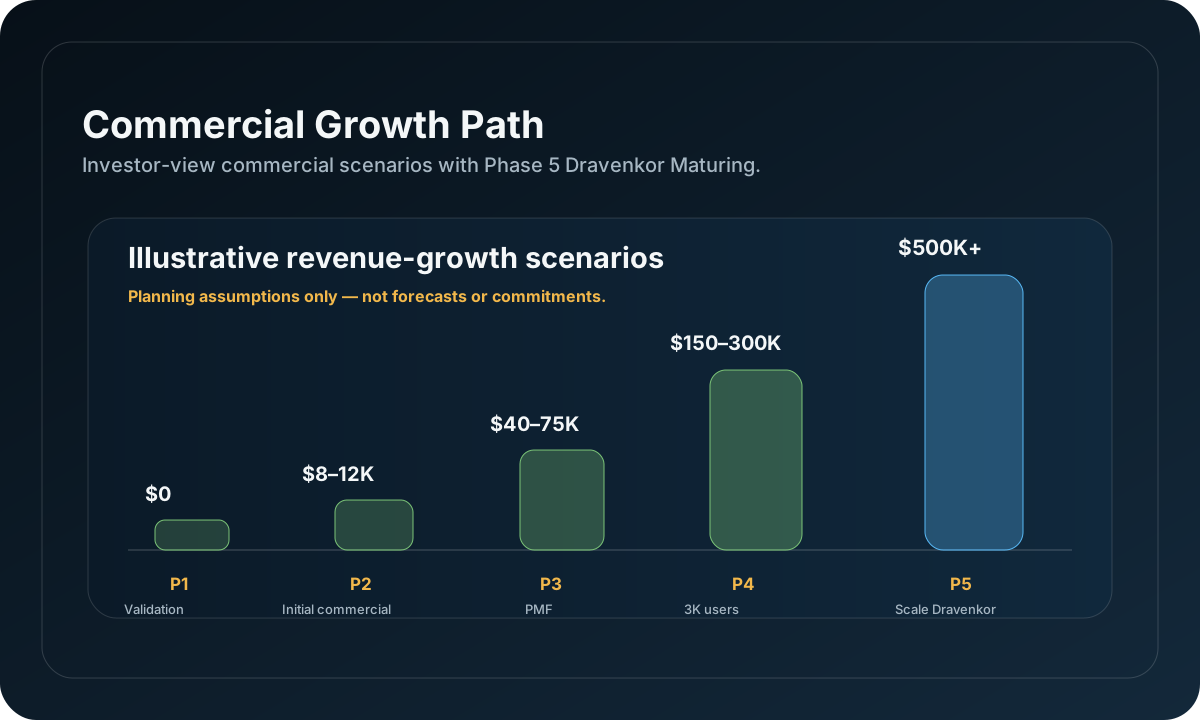
Illustrative commercialization scenarios
| Phase | Target indicators | Illustrative annual revenue | Primary goal |
|---|---|---|---|
| Phase 1 — Community Validation | 100–250 Community users; 25+ Technology Health Reviews; 10+ contributors; 5+ success stories | $0 | prove value and vocabulary |
| Phase 2 — Initial Commercialization | 500 Community users; 40 Plus subscribers; 10 Pro subscribers | $8,000–12,000 | demonstrate willingness to pay |
| Phase 3 — Product-Market Fit | 1,500 Community users; 150 Plus subscribers; 50 Pro subscribers | $40,000–75,000 | reach sustainable operation |
| Phase 4 — Growth | 3,000 Community users; 600 Plus subscribers; 150 Pro subscribers | $150,000–300,000 before services | scalable ecosystem growth |
| Phase 5 — Dravenkor Maturing | 5,000+ Community users; 1,000+ Plus/Pro subscribers; 5+ key clients with specialized services and support | $500,000+ annually | scale Dravenkor |
Key validation metrics
The strongest indicators are not vanity traffic metrics. They are proof that people engage with Technology Health as a discipline:
- Technology Health Reviews completed;
- improvement roadmaps created;
- Community workflows shared;
- Community success stories;
- review-to-subscription conversion;
- improvements achieved and confidence gained.
Sensitivity and risk notes
| Risk | Why it matters | Validation response |
|---|---|---|
| Support load | Community growth can create founder/operator drag | document repeatable workflows and self-service guidance early |
| Conversion uncertainty | paid behavior is not proven yet | treat Phase 2 as willingness-to-pay validation, not revenue destiny |
| Data quality | recommendations depend on credible evidence | keep proof-loop source traceability and degraded-mode honesty visible |
| AI dependency perception | reviewers may over-index on AI claims | position DORI as guidance with confidence and review posture, not magic automation |
| Implementation complexity | broad integrations can sprawl | start with Community proof-loop anchors and capability-pack boundaries |
Investor takeaway
The commercial thesis is that Technology Health can become a measurable operating discipline. As adoption grows, subscriptions, reviews, capability packs, and advisory services create multiple paths toward sustainable revenue — but every path is gated by validation, evidence, and trust.
Reviewer questions
- Is the assumption boundary clear?
- Do the growth scenarios feel useful without reading as forecasts?